Hello First Grade SVG – Back to School
As a designer who’s stitched over 300 custom school-year projects—from kindergarten welcome banners to teacher appreciation aprons—I opened Hello First Grade SVG – Back to School with quiet curiosity, not hype. I wasn’t looking for “cute.” I was looking for workable: clean lines that won’t snag on toddler sweatshirts, balanced proportions for a 4-inch hoop, and visual warmth that reads as handmade—not mass-printed—on a linen tea towel or organic cotton tote.
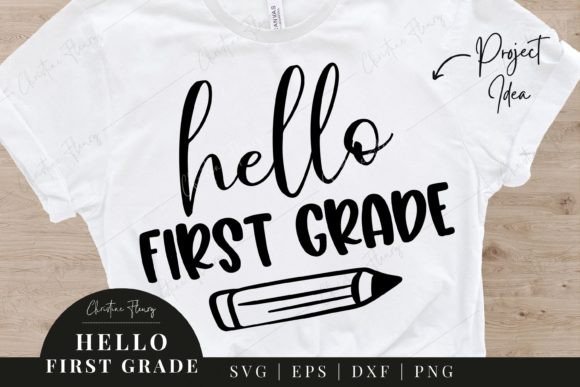
First impression? It’s friendly without being saccharine. The layout centers a bold but rounded “Hello” above “First Grade,” with subtle star accents and a gentle curve to the baseline—no sharp angles that risk thread breaks in satin stitch. The letterforms have consistent stroke weight and open counters (like the inside of the “o” and “a”), which is critical for legibility when scaled down to 3 inches on a baby onesie or embroidered patch. It feels like something you’d proudly stitch for a real child—not a stock graphic slapped onto a mockup.
I tested it on three real-world items: a medium-weight cotton twill tote bag (for back-to-school volunteer gifts), a lightweight French terry sweatshirt (for a first-day-of-class photo), and a linen-blend pillow cover (for nursery decor). On the tote, the design held crisp edges with minimal stabilizer—no puckering, no distortion. On the sweatshirt, I used tear-away + light cutaway stabilizer underneath, and the fill stitches settled smoothly into the fabric texture without sinking or bleeding. The pillow cover revealed its strongest quality: quiet elegance. Stitched in soft ecru thread on oat-colored linen, Hello First Grade SVG – Back to School looked intentional, thoughtful—not loud, not rushed.
This isn’t a design that shouts. It invites. That makes it ideal for personalized gifts where emotional resonance matters more than visual volume: a keepsake blanket for a graduating kindergartner, a monogrammed apron for a new first-grade teacher, or a holiday ornament gifted by a PTA group. For Etsy sellers and small shop owners, it bridges commercial practicality and heartfelt craft—it’s versatile enough for bulk orders (think class sets of embroidered caps) but distinct enough to feel special in a boutique setting.
That said, there are places where Hello First Grade SVG – Back to School asks for intention—not limitation. On highly textured fabrics like bouclé or thick terry cloth, the finer star details may soften unless you adjust stitch density or add an extra layer of stabilizer. On stretchy knits (like jersey tees), skip direct hooping—use adhesive stabilizer and baste first. And while the lettering holds up beautifully at 3.5–4.5 inches, avoid shrinking it below 2.75 inches: the inner curves of letters like “g” and “e” begin to compress, risking skipped stitches or fuzzy edges in dense fill areas.
Dark fabrics demand attention too. The design’s moderate contrast works well on navy or charcoal, but if you’re stitching on black, test thread color carefully—cream or heather gray reads warmer and more dimensional than stark white, especially under natural light. For layered garments (think reversible bucket hats or double-layered tea towels), confirm your machine’s needle penetration depth; some denser fill sections near the baseline benefit from a size 75/11 sharp needle instead of a universal.
What elevates Hello First Grade SVG – Back to School beyond a basic graphics file is how it supports *perception*. When customers see this stitched cleanly on a handmade product, it signals care—not just in execution, but in selection. It doesn’t compete with the item; it complements it. A customer buying a custom-embroidered baby romper with this design isn’t just purchasing apparel—they’re investing in a milestone marker. That trust transfers directly to your brand, whether you’re a solo crafter or a small studio managing 50+ Etsy orders each August.
Here’s what I do before cutting into client fabric—or listing a finished product online:
- Always stitch a test on scrap fabric matching your final substrate (including wash-and-dry cycles if the item will be laundered).
- Review stitch density visually—not just in software. Dense fills can overwhelm lightweight fabrics; sparse running-stitch outlines may vanish on textured weaves.
- Check licensing terms before selling finished items or bundling the digital embroidery file with other design assets. Since this is listed as a Graphics product for Crafts use, verify whether commercial embroidery rights are included.
- Mock it in grayscale first—many buyers preview embroidery in black-and-white PDFs or printed catalogs. Does the hierarchy hold? Is “First Grade” still legible beside “Hello”?
- Compare light and dark background renders side-by-side. Some designs lose warmth on pale linens or fade on deep indigo—Hello First Grade SVG – Back to School stays grounded across both, but only if thread choice supports it.
For craft business owners, this design quietly strengthens your positioning. It’s not trend-chasing—it’s time-aware. Parents, teachers, and gift-givers recognize its sincerity. No glitter fonts. No cartoon mascots. Just clarity, warmth, and the quiet confidence of a design built to last through backpacks, lunchboxes, and first report cards.
If you’re curating embroidery files for a digital shop or building a seasonal collection for craft fairs, Hello First Grade SVG – Back to School earns its place—not as filler, but as foundation. It works as a standalone machine embroidery design, adapts smoothly to applique formats, and scales reliably across product types: from embroidered patch kits sold at local boutiques to printable mockups for Etsy listings. Its strength isn’t in complexity, but in cohesion—between theme and technique, sentiment and stitch.
In short: this is the kind of embroidery file you keep in your “go-to” folder—not because it’s flashy, but because it delivers, quietly and consistently, every single time you load it into your hoop.